18 November 2010

What's the purpose of education?

So … there are two main theories of curriculum design – product and process – that can be used to help us understand course design, development, and delivery. While both models deal with common elements (objectives, content, method, and assessment / evaluation), in the product model, knowledge (and learning) is bounded and packaged. Once a course has been designed and the parameters of the course established, students are guided through the pre-defined learning experiences and finally tested to see how well they have achieved desired learning outcomes. The process model, on the other hand, is more fluid and provides for collaborative exploration of the field by both teacher and student. The teacher is expert, the student novice, but they occupy and investigate the subject matter together. The former guides the student, while leaving room for the student to construct his or her own learning experiences and pathways. In practice, these models probably lie at opposite ends of a continuum, rather than each in their own box.

For instance, if the conversation is focused on the ways in which research is or could be used in undergraduate teaching, the product model aligns with Healey and Jenkins’ notion of research-led teaching, whereas the process model of curriculum design might be employed in a situation where the teacher is employing research-based or even research-tutored teaching (Healey & Jenkins, 2009). Healey and Jenkins differentiate in their model between student as audience and student as participant, and these, for me, are the key differences between the product and process models of curriculum design. It should be noted that it is possible for a teacher, in a single course / subject, to provide learning experiences that address all four aspects of the Healey & Jenkins model.


The nature of undergraduate research and inquiry (Healey & Jenkins, 2009, p 7)

In my work with teaching academics in a research-intensive Australian university, I don’t hear academics talking about the theory that underpins their teaching practice. Let’s face it, I don’t hear them talking about their teaching very often at all. Discussions about curriculum usually centre around topics and core knowledge, even among the accountants who have recently been involved in a conversation about the graduate attributes of their cohort.

Is this something that universities should be concerned about? I think so, given the information we are getting about how TEQSA will approach issues of quality and standards.

I’m not sure that teaching academics even have a common understanding of curriculum or the design of learning environments and experiences. This is supported by a study conducted in Australia by Fraser and Bosanquet. They write that four different categories of meaning emerged when academic staff were asked about their understanding of the term curriculum: Category A: The structure and content of a unit / subject; Category B: The structure and content of a progam of study; Category C: The students’ experience of learning; and Category D: A dynamic and interactive process of teaching and learning (Fraser and Bosanquet, 2006).

Those using Categories A & B, according to Fraser and Bosanquet, “conceptualize the curriculum as a product that can be defined and … recorded”. Those using Category C conceptualize the curriculum as a process that facilitates student learning, and those using Category D view the curriculum as a dynamic, emergent and collaborative process of learning for both student and teacher. (Fraser and Bosanquet , 2006, p 272) Clearly, Categories A and B align with the teacher-centred, content-oriented product models of curriculum design, and Categories C and D with the learner-centred, learning activity-oriented process models. They conclude that academics associate many different meanings to the term curriculum, and that these variations extend to “the epistemological assumptions that underpin [their] understandings”. Fraser notes that the “impact of such a variation in understanding on the teaching and learning processes and practice of the institution is not well known”. It is her view that an exploration of the meanings of the term curriculum and the language of teaching and learning could in itself become a useful focus of the partnership between higher education developers, discipline experts, and university leaders (Fraser, 2006).

None of the Fraser-Bosanquet categories address perhaps the most important factor shaping curriculum design decisions: beliefs about the purpose of education. An Irish academic developer, new to the work, wrote in 2010 of her struggle to find an appropriate starting point for her work. She turned to the literature and discovered that “one aspect that appears to be quite diverse in its presentation is the start of the process”. Some of the authorities she consulted pointed out that curriculum design models often overlook “personal attitudes, feelings and values involved in curriculum making”, while being strongly influenced by the discipline. She quotes Stark, who recommends early exploration of staff considerations and beliefs (O’Neill, 2010). Advocates of the process model frequently recommend something along these lines. Hawes, for example, includes in his model a range of guiding principles, including theories of child behavior, teaching and learning, and epistemology (Brady, 1995). Walker writes of the platform upon which a curriculum designer bases decisions, and lists beliefs, theories, conceptions, points of view and aims / objectives (Print, 1993).

Many writers have addressed this issue of the foundation upon which decisions about curriculum are made. So, what should education foster and facilitate? In the literature, we find a range of conceptions or ideologies about the purpose of education.

1. The polymath (Posner, 1995; Smith, 2000): The first, and the one least applicable in a modern university setting, is the notion that there is core body of knowledge which will be familiar to all educated people. Exponential growth in the sum of human understanding means that it is now almost impossible for most people to know something about everything, but this was not always the case.

2. Social efficiency (Posner, 1995; Smith, 2000; Schiro, 2008): Those who subscribe to this notion believe that the purpose of education is to meet the needs of society, by preparing citizens to function as mature contributing members of society.

3. Discipline-based, scholarly endeavour (Eisner & Vallance, 1974; Print, 1993; Posner, 1995; Schiro, 2008): This concept is based on the value of discipline-based knowledge. It values content knowledge, the skills of the discipline, and the ontology and epistemology of the discipline. Those designing curriculum with this concept in mind believe that the purpose of education is to help students acquire the accumulated knowledge of the academic discipline in question. Such curriculum addresses not the topics particular to the discipline and enables students to use and appreciate the ideas and works that constitute the discipline. Such designers sometimes refer to “core knowledge” for their discipline.

4. Cognitive development (Eisner & Vallance, 1974; Print, 1993; Posner, 1995; Smith, 2000): This concept aligns with the idea of generic skills. Those who build on this foundation believe that the purpose of education is to give students the skills they need to learn how to learn, and to employ and enhance their intellectual abilities. Discipline knowledge is important, but more importantly, it provides the content base that allows students to acquire and rehearse generic skills. Discipline-based knowledge is instrumental to the development of intellectual abilities that can be used in areas other than those in which the processes were originally refined.

5. Humanistic, learner-centred experiences (Eisner & Vallance, 1974; Print, 1993; Posner, 1995; Schiro, 2008): These designers believe that education ought to provide students with intrinsically rewarding experiences to enhance personal development and enable them to achieve self-actualization. Content is selected according to student interest. The focus of curriculum designed on this basis is the interests and concerns of students, and the goal of education is the personal growth of individuals.

6. Social reconstruction (Eisner & Vallance, 1974; Print, 1993; Smith, 2000; Schiro, 2008): Social constructionists base their practice on the works of writers like Giroux, Illich, Friere and Habermas. For them, the purpose of the curriculum is the reform of society. Education is designed to facilitate the construction of a new and more just society that offers maximum satisfaction to all, and school is an agent for change. These designers sit at the radical end of the political spectrum.

7. Educational technology (Eisner & Vallance, 1974; Print, 1993): It could be argued that educational technology is not a separate category, but rather an approach that supports the social efficiency conception of curriculum. The educational technologists are less concerned with process and more interested in the “technology” by which knowledge is communicated and learning facilitated. They rely on a very broad definition of technology that includes not only material objects (software and hardware), but also systems, methods of organization, and techniques. They draw on theories of behaviourism, cognitivism, constructivism, and connectivism (see Siemens and Downes). The instructional techniques and strategies employed by educational technologists include problem-based learning and inquiry-based learning in a student-centred environment. This approach has informed distance, flexible, and online education.

This leaves me with two questions:

• How do I find out about the philosophy of education that underpins decisions about curriculum design made by my academic colleagues?

• How do I encourage my academic colleagues to share with each their understanding of the term curriculum?

***

References

Brady, L. (1995). Curriculum development, 5th edn. Sydney, Prentice-Hall.

Eisner, E. W. and Vallance, E. (1974). Conflicting conceptions of curriculum. Berkely, McCutchan Publishing Corporation.

Fraser, S. (2006). Shaping the university curriculum through partnerships and critical conversations. International Journal for Academic Development, 11(1), 5-17.

Fraser, S., and Bosanquet, A.M. (2006). The curriculum? That’s just a unit outline, isn’t it? Studies in Higher Education, 31(3), June 2006, 269-284.

Healey, M. and Jenkins, A. (2009). Developing undergraduate research and inquiry. York, The Higher Education Academy.

O’Neill, G. (2010). Initiating curriculum revision: exploring the practices of educational developers. International Journal for Academic Development, 15(1), 61-71.

Posner, G. J. (1995). Analyzing the curriculum, 2nd edn. New York, McGraw-Hill.

Print, M. (1993). Curriculum development and design, 2nd edn. Sydney, Allen & Unwin.

Schiro, M. S. (2008). Curriculum theory: conflicting visions and enduring concerns. Los Angeles, Sage.

Smith M. K. (1996, 2000). Curriculum Theory and Practice. The enclyclopaedia of information education, www.infed.org/biblio/b-curric.htm.

15 November 2010

Models and theories of curriculum design

“When teachers are asked to develop a curriculum, part of the requirement is to formalize that undertaking by writing it in the form of a curriculum document. The format of that document is almost invariably a statement of the objectives, content, method, and assessment in that order. Such a presentation may predispose teachers to adopt this format as a model for curriculum development, and thereby use an objectives model in the development stage. There would certainly be few, if any, curriculum documents where the objectives are presented at the end, even though this sequence might be a reflection of how the curriculum was developed. So the obvious logic in presentation need not parallel the method of development.”
(Brady, 1995, p 85)

This week, I’ve been reviewing models of curriculum design, partly because I’m giving a paper at the ASCILITE conference in Sydney in a couple of weeks about the Bones Model which underpins my own practice, and partly because of the whole learning outcomes = standards thing that seems to underpin some of the paperwork doing the rounds (see TEQSA and the ALTC standards project).

Accepted models of curriculum design emerging from studies of school-based education last century, are classified as “product” (aka rational – Print, 1993 or objectives – Tyler, 1949), “interactive” (Taba, 1962), “cyclical” (Print, 1993), or “process” (Wheeler, 1967; Stenhouse, 1975, and Hawes, 1979). Biggs’ model of constructive alignment, written for the higher education sector, owes much to the work of these early school-based models.

The best known of these is probably the linear product model. The assumption underpinning this model is that there is an agreed body of knowledge that students need to learn. It starts with a statement of objectives, follows with descriptions of content and method (selection and organization of teaching and learning activities), and finishes with evaluation, which generally encompasses both assessment strategies and evaluation of the curriculum. In these models, objectives serve as the basis for devising subsequent elements, with evaluation (assessment) indicating the degree of achievement of those objectives. The focus is on teaching.

Tyler’s 1949 model, one of the earliest linear examples, is based on the four questions he poses:

1. What educational purposes should the institution seek to attain [objectives]?

2. What educational experiences are likely to attain these objectives [instructional strategies and content]?

3. How can these educational experiences be organized effectively [organization of learning experiences?

4. How can we determine whether these purposes are being attained [assessment and evaluation]?
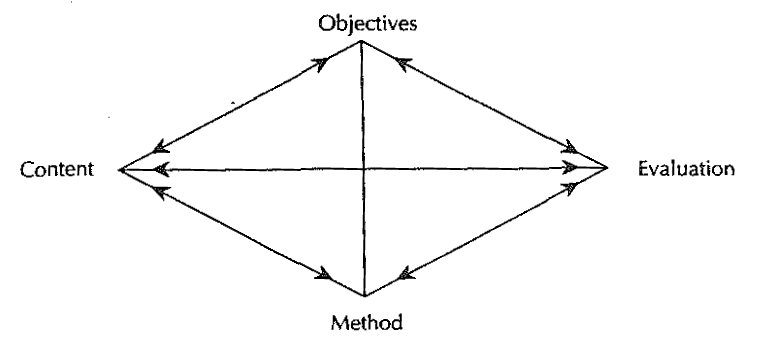
His highly influential model was modified by Taba, who proposed a variation that recognized that while documenting the curriculum can be linear and logical, the process of design is a lot messier. Her interactive model adds the idea of a needs analysis, and reflects more accurately actual iterative design practice.


Figure 1: Taba’s Interaction Model (Brady, 1995, p 81)

The cyclical models from the next stage in the evolution of curriculum design are similar in many ways to the linear and interactive models that preceded them. They incorporate the same or similar elements – initial situation analysis, identification of aims and objectives, selection and organization of content, selection and organization of learning activities, followed by an assessment / evaluation process (Wheeler, 1967; Nicholls & Nicholls, 1978). All of these product models – linear, interactive, and cyclical – are efficient, logical and clear. They probably don’t reflect actual curriculum design practice for most teachers, but they serve as useful checklists and tools for documenting curriculum.

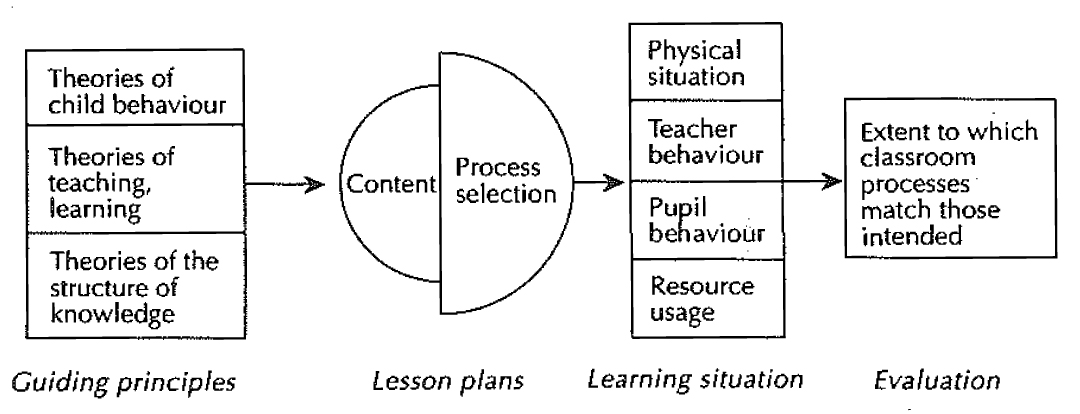
The process models that followed them (Print calls them “dynamic” models) are more interesting. In the student-centred process models, the teacher’s role is that of facilitator rather than content authority. These models assume curriculum design to be an ongoing process, dependent on emerging information and practice, shaped by the beliefs, experiences, theories and philosophies held by those planning the learning environment. These models go well beyond the core elements of objectives, content, method, and assessment / evaluation, although these are recognized as part of the process. Hawes, for instance, shows that designers draw on theories from psychology, teaching and learning, and epistemology in making decisions about content and process selection. There can be problems with classrooms designed along these lines. For example, it may be difficult to ensure consistency of content coverage from cohort to cohort, and the quality of learning is very dependent on the quality of teaching. Attempts to compensate for these aspects have contributed to the discovery learning and problem-solving movements.


Figure 2: Hawes’ Process Model (Brady, 1995, p 84)

Walker is even more general, listing beliefs, theories, conceptions, points of view and aims / objectives.


Figure 3: Walker’s Model (Print, 1993, p 75)

So how are the product / interaction / cyclical models different from the process / dynamic models? The product models are prescriptive, the process models descriptive. The role of assessment is different. The former have clear objectives and aligned assessment strategies (generally prepared before the start of classes) designed to test how well students have achieved the learning outcomes; the latter may have assessment strategies designed to find out what students have learnt, and a highly diluted focus on learning outcomes.

It’s pretty clear that Biggs’ notion of constructive alignment owes more to the former (objectives) model of design than the latter, as do the many models of Instructional (Systems) Design aligned with the ADDIE approach familiar to instructional designers and those who have worked in distance education (see Dick & Carey’s Systems Approach, Esseff & Esseff’s Instructional Development Learning System (IDLS), and Romiszowki’s Instructional Systems Design (ISD), among others).

More recently, there have been some efforts to develop new models for higher education. Bell & Lefoe, writing in the late 90s, identified a lack in the traditional instructional design models which had not previously provided for decisions about media and the provision of flexible access. They proposed an early flexible learning curriculum design model that addressed decisions about media use. This aspect of designing curriculum for flexible and online delivery has become increasingly important as tertiary institutions across the world have rolled out Learning Management Systems and started to use social networking tools. Irlbeck, Kays, Jones & Sims describe their Three-Phase Design (3PD) Model as emerging from the blurring of the distinction between online and distance education (Irlbeck, Kays, Jones & Sims, 2006). The 3PD model provides for a team-based approach to the design, development, and delivery of online courses and deals not only with the initial development of learning materials and online environments (Phase 1: Preparing functional requirements), but also ongoing review and revision phases (Phase 2: Evaluate, elaborate and enhance, and Phase 3: Maintain).

In spite of this work, and the long history of curriculum design theory, models of curriculum design are not widely known amongst Australian academics.

And yet, and yet … academics in Australian universities do design curriculum, and they seem to be having some reasonable success in teaching their disciplines with little or no knowledge about these theories of curriculum design.

How can this be?

Well, I’ll be pondering this at length and posting more on the topic soon.


References

Bell, M., & Lefoe, G. (1998). Curriculum design for flexible delivery – massaging the model. In ASCILITE '98 : flexibility the next wave? : proceedings of the 15th Annual Conference of the Australasian Society for Computers in Learning in Tertiary Education, December 14th to December 16th, 1998.

Biggs, J. & Tang C. (2008). Teaching for quality learning at university. Sydney, McGraw-Hill.

Brady, L. (1995). Curriculum development, 5th edn. Sydney, Prentice-Hall.

Hawes, j. (1979). Models and muddles in school-based curriculum development. The Leader, 1.

Irlbeck, S., Kays, E., Jones, D. & Sims, R. (2006). The Phoenix Rising: emergent modes of instructional design. Distance Education, 27(2), August 2006, 171-185.

Nicholls, A & Nicholls, S. (1972). Developing a curriculum: a practical guide. London, Allen & Unwin.

Print, M. (1993). Curriculum development and design, 2nd edn. Sydney, Allen & Unwin.

Stenhouse, L. (1975). An introduction to Curriculum Research and Development. London, Heineman.

Taba, H. (1962). Curriculum development: theory and practice. New York, Harcourt, Brace, and World.

Tyler, R.W. (1949). Basic principles of curriculum and instruction. Chicago, The University of Chicago Press.

Walker, D. (1971). A naturalistic model for curriculum development, School Review, 80(1), 51-65.

Wheeler, D.K. (1967). Curriculum process. London, University of London Press.

09 November 2010

The Perfect Teacher

In a recent post at elearnspace, George Siemens gives us his list of six "key skills for educators". These are areas in which teachers need to be competent and comfortable. I see them as characteristics that can (should, in an ideal world ?) be used to shape curriculum. Siemens has written much more extensively and formally on these issues elsewhere, but the blog is a neat little introduction to some of his ideas.

His list of six, in summary:
  • technical competence: Siemens' idea here is that teachers need to know the technology of the time and place, and to understand that tools are not neutral. Rather, they create adjacent possibles*. He says that "using any tool well requires a blend of technical competence and awareness of pedagogical opportunities".
  • experimentation: Curriculum can't be static. Educators need to experiment, "refining their learning approach to constantly changing contexts".
  • autonomy (learner, not teacher): Learners need to be constructing their own learning, and teachers need to give them room to do that.
  • creation: Giving learners room to create through intentional experimentation provides opportunities for the learning environment to evolve.
  • play: Siemens contrasts experimentation (see creation above) and play; play, he says, is random exploration without a goal or target - flexible, personal and engaging. Students need to play as part of the learning process.
  • developing capacity for complexity: The world is complex, and answers are more like a canvas painted in response to a problem landscape than lego-blocks that need to be clicked together. Students need to learn to tackle complexity.
Teachers who take these ideas into consideration won't be using a linear Tyler-style model of curriculum design. Their classroom will be messy and complex, and responsibility for learning will be shared between teacher and students. Wouldn't that be exciting?

****

*"Now I define The Adjacent Possible. Consider a flask of 1000 kinds of organic molecules, and call them the Actual. Now consider all one step reactions among the Actual. It might be that novel molecules are formed. Call these “the Adjacent Possible” given the Actual in the flask. This Adjacent Possible is perfectly definable given reaction conditions and a minimal lifetime of a chemical species." Stuart Kauffman

20 October 2010

Where do the bright shiny things live?

It’s a lot easier to create content for the Web than it used to be. Only a couple of years ago, it was pretty difficult to make beautiful things to add to a website without sophisticated authoring tools and skills well beyond anything I could possibly be bothered to acquire. Now, just keeping track of the tools is almost impossible.

I rely almost exclusively on a fantastic site called Paul’s e-learning resources. Paul, whoever he is, has gathered together an amazing list of free, easy-to-use tools that can be used to produce “high quality resources that can be used on any web-enabled platform”. Teachers around the world need to bookmark this site. You’ll find this treasure trove at http://sites.google.com/site/technologyenhancedlearning/.

The variety of the materials on the site, and the speed with which it grows, will help to prevent you from becoming victim to Baby Duck Syndrome (BDS) … a truly delightful concept. According to wisegeek.com (via Stephen Downes):

Baby Duck Syndrome is a term used to refer to the tendency of computer users to prefer the systems that they learn on, and to reject the unfamiliar. In addition to applying to operating systems, Baby Duck Syndrome applies to software programs, keyboard layouts, and other electronics. This concept has a firm basis in psychology, as many humans have a known preference for maintaining the status quo, rather than exploring new possibilities ... This technical term is a reference to the work of Konrad Lorenz, a psychologist who actually studied geese, not ducks, although his work could be generalized to ducks. He learned that when baby birds hatch, they "imprint" on whatever moving thing they first see, whether or not that thing is a parent. Lorenz famously got several clutches of goslings to imprint on him, and there are some charming photographs of Lorenz teaching the young geese how to swim, eat, and perform other tasks.
(Well, that explains the LMS cults.)

However … back to Paul. This week, Paul introduces us to Voisse (a free tool that can be used to create audio journals, among other things), Markup.io (“a neat little bookmarklet … that you can click on anytime to start annotating whatever webpage you are on at the time … your annotated page is then given a unique URL which can be shared”), Muvizu (a tool for making 3D animated movies), and Spicynodes (helps you to make mind maps of the content you’ve put into your LMS site). … and that’s just the beginning of the tools he has tested and reviewed, and to which he has provided links.

So, if you are looking for new and interesting ways to present content, or to engage students in authentic learning activities, or to avoid BDS, go and visit Paul.

21 September 2010

"Chance favours the connected mind"

In between working on the projects on my desk and attending the meetings in my diary for today, I've been listening to Steven Johnson talk about Where Good Ideas Come From on TED, and reading the latest ECAR Research Bulletin: Strategic Directives for Learning Management System Planning.

Johnson is the kind of speaker that we expect from the TED presentations. He is slick, entertaining, and makes a couple of points well, by telling stories to illustrate his argument. His point in this presentation is that innovation happens when the unplanned, emergent, unpredictable power of open, innovative systems is allowed to take us in unexpected directions. The stories he tells in this presentation are about the value of cross-fertilization of ideas, particularly amongst unexpected collaborators. He says that we frequently present new ideas as bolts from the blue, epiphanies that occur without warning. In fact, he says, more often than not, ideas "fade into view". They arrive after a long incubation period, often after a hunch has been cultivated. I'm coming pretty close here to mixed metaphors, so I'll step back from reporting on Johnson's presentation. In any case, you can see the whole thing for yourself – it's only about 20 minutes long.

In the ECAR Bulletin, White & Larusson address an issue that has been up for discussion among my colleagues recently – a classification system for websites created using a Learning Management System.

I am currently using three categories: Campus, Blended, and Distance. These are based on where the students are, and how their course is delivered. My definitions are not dissimilar to those used by many institutions in Australia. They should not be read as hierarchical. Those who are designing learning environments would, I hope, use these definitions to help them decide which kind of site would be the best for the purpose at hand.

1. Campus: The course is designed to be delivered face-to-face. The LMS site provides back-up copies of course materials, i.e. the Course Outline, recordings of lectures, lecture handouts. Student-student interaction is non-existent or minimal (e.g. a social forum may be the only online contact students have with each other). The only online assessment activity, if there is any, is use of the quiz tool, or online submission of assignments.

2. Blended: The course is designed to be delivered partly face-to-face and partly online. LMS-based activities, e.g. discussions, simulations, or quizzes, are core activities designed to enhance learning. They count towards the final mark. Web-conferencing may be used.

3. Distance: The course is designed for students who do not attend any campus-based events, i.e. students who study at a distance from the university campus and are not visited by the lecturer. The full range of online teaching tools is considered in the design of the site, and many are used to their full advantage.
I also talk, in some of my training sessions, about the three sets of tools that an LMS provides – tools of:

• Administration,

• Dissemination, and

• Collaboration and Co-operation.
White & Larusson's categores are Transmission, Evaluation, and Interaction. In their paper, they bring together the ideas that gave me my categories for delivery modes and tool classification options. Their Transmission category matches my Campus category fairly closely, and uses the tools I group together under Dissemination. Their description of their Evaluation category draws on some but not all of the tools I classify as Administration. Specifically, they write of the value of the tracking tools, which allow the lecturer to monitor patterns of access by students. They suggest that information collected in this way about how the group is learning can be used by the lecturer to modify and evolve learning activities over several iterations of a course. Their Interaction category uses the tools I classify as Collaboration and Co-operation. Then, they go on to give us nine points to guide thinking about how an LMS ought to be implemented.

So – to bring these ideas together – I suspect that I am harbouring one of Johnson's "slow hunches". The idea hasn't yet faded into view, so I need to write about it, to put it out there in the world for discussion.

How much learning in a university ought to happen behind the walls of the institution, and how much ought to happen in public? How much student effort (in the form of completed assignments) ought to be made public? If ideas are "networks", as Johnson says, and not "single things", what are the implications for the way we build online learning environments, the way we train our students to think about things and solve problems, and the ways we assess student achievement? If we value innovation, and true innovation comes from collaboration, and ideas are not single things but networks that fade into view as the collective creates them ... what then?

Hmm-mm – I think I need to let this one simmer for a good while longer.

15 September 2010

Thoughts of the day

David Jones posted an entry to his blog today in which he refers to a 2003 interview with Alan Kay.

Kay says, in the interview:
"But I think the big problem is that schools have very few ideas about what to do with the computers once the kids have them. It's basically just tokenism, and schools just won't face up to what the actual problems of education are, whether you have technology or not.
Think about it: How many books do schools have—and how well are children doing at reading? How many pencils do schools have—and how well are kids doing at math? It's like missing the difference between music and instruments. You can put a piano in every classroom, but that won't give you a developed music culture, because the music culture is embodied in people.

On the other hand, if you have a musician who is a teacher, then you don't need musical instruments, because the kids can sing and dance. But if you don't have a teacher who is a carrier of music, then all efforts to do music in the classroom will fail—because existing teachers who are not musicians will decide to teach the C Major scale and see what the bell curve is on that.

The important thing here is that the music is not in the piano. And knowledge and edification is not in the computer. The computer is simply an instrument whose music is ideas.

Educators have to face up to what 21st-century education needs to be about, and start thinking about solving that problem long before they bring the computer on the scene."
Not unexpectedly (to those of you familiar with my opinions on such matters, at least), I find myself immediately attracted to this idea. We all know that giving people hammers and chisels won't turn them into master carpenters any more than putting pianos in classrooms will turn students into musicians. Why then do so many of my tribe* persist in the belief that merely giving university teachers and students access to an LMS will either change teaching practice or improve the learning experience?

Of course, it won't – not without many other changes, most of which can be traced back to the need to ensure that all university teachers are expert in both the body of knowledge that comes from their discipline and also in the practice of teaching.

So ... can we please stop talking about e-learning and focus our attention on good curriculum design and excellence in teaching?

But that's enough of that old groove.

Here's something much more interesting ...

This afternoon I am playing in the background a presentation by the very excellent Michael Feldstein. Feldstein works for Oracle as "software strategist and product manager", and maintains the e-Literate blog. He knows more about Learning Management Systems than most – the culture and the history as well as the architecture and the coding. His presentation – W(h)ither the LMS? – explains why the world is ready for the next generation of LMSs, what they might look like, and how they will be designed and built. Forget discussions about mythical PLEs – listen to Feldstein and imagine a future where online learning environments are properly integrated and truly permeable.

Ahh-hhhh ....


------
* ... and by "so many", I mean "any".

17 August 2010

Issues of the day: quality, compliance, and English language fluency

Two articles in the online edition of The Australian's Higher Education supplement caught my attention today.

The first reports on comments from academics teaching in the business disciplines in Australian universities (along with others who have an opinion about TEQSA and the ALTC disciplines setting standards project). I won't repeat the content of the article – you can read it for yourself.

A number of issues are highlighted by the article: the challenges ahead for TEQSA, the tussle between RTOs and the higher education sector (particularly universities and especially the Group of Eight), the question of an agreed definition of quality and how this might be measured, and the seeming disconnect between the implementation of recommendations from the Bradley and Cutler Reports.

Universities don't come out of this one looking good. The RTOs and the VET sector seem to be very willing to demonstrate that they have carefully aligned curricula with assessment strategies that test how well students have achieved clearly articulated learning outcomes. Universities, and in particular the Group of Eight universities, seem to be inclined towards the view that no one has any right to ask them to demonstrate how they measure academic achievement. If TEQSA is funded appropriately, and universities are required to participate in its compliance checks, many academic staff will be running to catch up with their colleagues teaching in other parts of the sector. In some ways, that is a bit unfair. Australian university lecturers, by and large, don't know much about teaching. They know about giving lectures, about running tutorial-based discussion groups, and about assessing how well students know the knowledge of the discipline, but most of them have no theoretical foundation to their teaching practice. Not their fault – they were hired because they know lots about their disciplines.

Maybe we should start by making it compulsory for all universities to enrol their teaching academics in proper teacher education programs – except, of course, those who already have a teaching qualification. At least then they would have the knowledge necessary to engage in a conversation about curriculum design and teaching strategies other than those invented in medieval Europe. We would, of course, have to acknowledge that this would take time away from research and current teaching activities – so we'll need to hire more academics to help with workloads, especially if we want the country to maintain research outputs and we intend to send more Australians to university. (And before you say anything, let me tell you that it's no good suggesting that Australian academics work harder or longer hours ... most of the good ones already put in 50, 60, or 70 hour weeks.)

Oh, yes, I suppose we could create two categories of university academic – the research academic and the teaching only academic. This, in my view, is a dreadful idea. It's the research that gives depth to teaching in universities. Many of the very best of our teachers are outstanding researchers as well.

So it's all a bit tricky.

The second article reports on moves by professions to require international students to pass English language tests upon graduation. Here's the thing: most Australian universities will enrol international students for whom English is a second (third, fourth) language if they achieve 6.5 on the IELTS test – somewhere between competent and good. This score does not guarantee that students are fluent in the language. That puts lecturers in a difficult position. It would be wrong to penalise students for poor English language skills unless fluency is a designated learning outcome for their chosen program of study – and because language skills are rarely articulated among program learning outcomes, they don't. That means that students who learn the declarative (foundational knowledge; knowing what or knowing about stuff in the discipline) and functioning knowledge (skills; knowing how to apply declarative knowledge to complete discipline-specific tasks) required by their course, and have sufficiently good English language skills to convey their understanding to the lecturer, pass the course. That gives us graduates – in accounting or nursing, for example – who can't get jobs because the employers expect a higher standard of English language skills.

That's all a bit tricky too.

Maybe the new government will have the answers.